
Have you ever logged into Blooket and wondered what all those buttons, menus, and statistics actually do?
You’re definitely not the only one.
The first time I explored Blooket, I clicked around for a few minutes before realizing that the platform was much more than a simple classroom game. Behind the colorful interface sits a control center that helps teachers create learning experiences, track progress, and manage classroom activities with surprisingly little effort.
That’s where the blooket dashboard comes in.
Whether you’re a teacher trying to organize quizzes, a student exploring educational games, or a parent curious about the platform, understanding how the dashboard works can make the entire experience easier and more productive.
Let’s take a closer look at what it offers and why so many educators use it as part of their classroom routine.
What Is Blooket?
Blooket is a game-based learning platform designed to make education more engaging. Instead of relying on traditional worksheets and quizzes, it transforms questions into interactive games that students can play individually or with classmates.
Teachers can create their own question sets or use existing content from the Blooket library. Students join games using a code and participate through any internet-connected device.
The platform has become popular because it combines learning with competition, rewards, and entertainment. Students stay focused because it feels like a game, while teachers still get valuable learning data.
Understanding the Blooket Dashboard
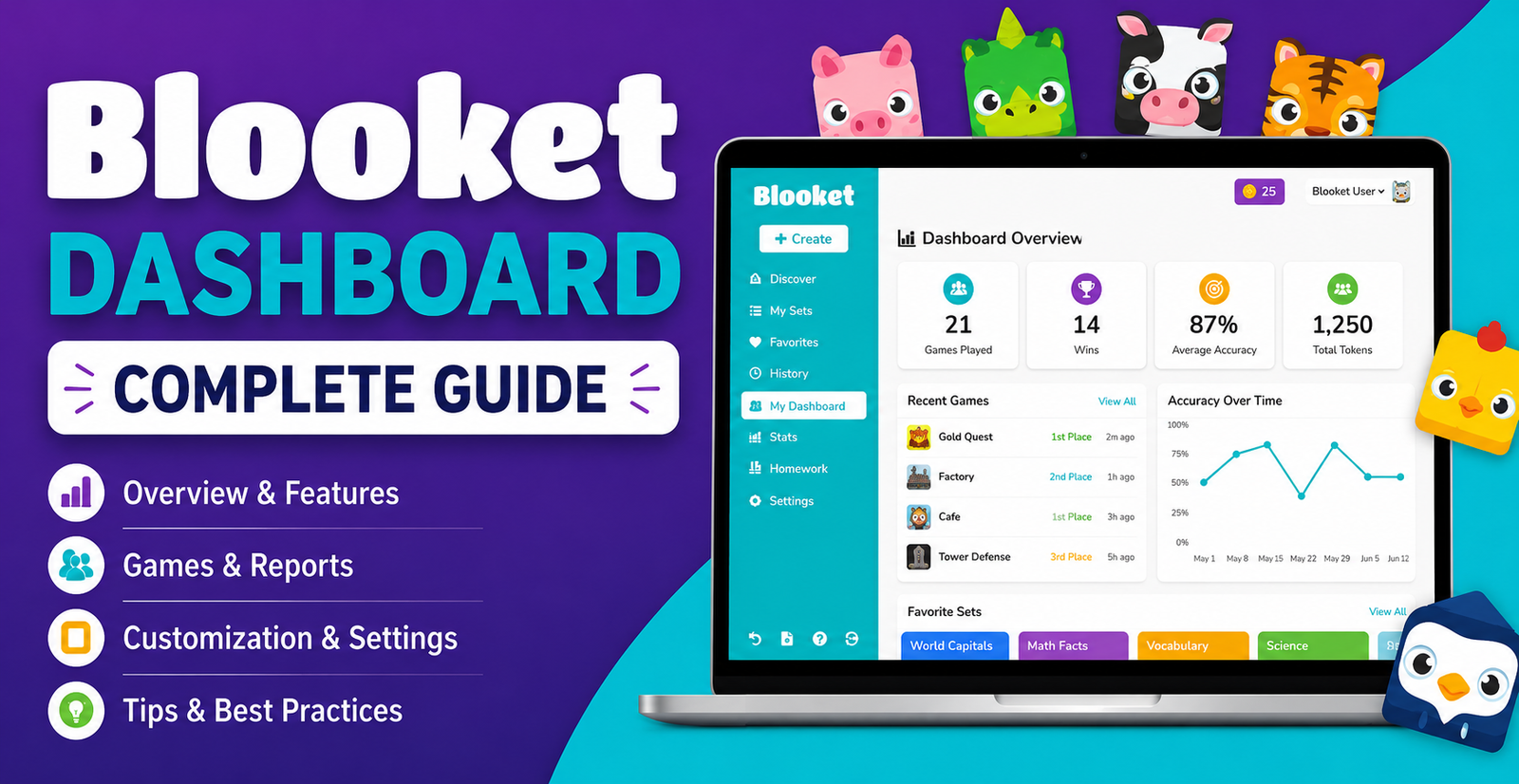
The dashboard acts as the main control panel of a Blooket account.
Once you sign in, this is the first area you’ll usually see. It provides access to essential features such as game creation, question sets, reports, account settings, and classroom management tools.
Think of it like the cockpit of an airplane. Everything important is organized in one place, making it easier to control and monitor your activities.
For teachers, the dashboard serves as a workspace where lessons can be prepared, launched, and reviewed.
For students, it provides access to account information, achievements, and available activities.
Key Features Found Inside the Dashboard
Home Overview
The home section gives users a quick snapshot of their activity.
Here you’ll typically find:
- Recent games
- Saved question sets
- Account information
- Activity summaries
- Quick-access shortcuts
This section helps users jump back into their work without searching through multiple menus.
Question Set Management
One of the most useful tools is the ability to manage question sets.
Teachers can:
- Create new sets
- Edit existing questions
- Organize content by subject
- Import question sets
- Share resources with others
For example, a science teacher preparing a lesson about the solar system can create a custom quiz in just a few minutes and save it for future classes.
Game Hosting Tools
Hosting games is where Blooket becomes exciting.
The dashboard allows teachers to:
- Select game modes
- Launch live games
- Set game preferences
- Control time limits
- Manage participants
Instead of manually organizing classroom competitions, everything can be handled through a few clicks.
Performance Reports
Data matters.
A fun classroom game is great, but understanding what students learned is even more important.
The reporting section provides insights such as:
- Student scores
- Correct answer rates
- Question difficulty
- Participation levels
- Learning progress
Teachers can quickly identify which topics need additional review.
Why Teachers Like Using Blooket
Teachers often struggle with student engagement.
Let’s be honest. Keeping a classroom focused isn’t always easy, especially when students have smartphones, social media, and countless distractions competing for their attention.
Blooket solves part of that problem by making learning interactive.
The dashboard helps teachers organize lessons efficiently while maintaining visibility into student performance.
Some common benefits include:
Easy Lesson Preparation
Creating a game takes significantly less time than designing traditional activities from scratch.
Many educators build reusable question sets that can be used year after year.
Increased Participation
Students who normally avoid classroom discussions often become active participants when game elements are involved.
Competition creates excitement.
Rewards create motivation.
And the result is often higher engagement.
Better Progress Tracking
The reporting tools save teachers hours of manual grading and analysis.
Instead of reviewing stacks of papers, performance information becomes available almost immediately.
Benefits for Students
Students often focus on the games themselves, but the dashboard also offers useful features.
Personalized Learning Experience
Students can review completed activities and monitor their progress.
This creates a stronger sense of ownership over learning.
Motivation Through Rewards
The platform uses points, achievements, and collectibles to encourage participation.
While these features may seem simple, they can have a surprisingly positive impact on motivation.
Interactive Learning
Reading from a textbook has its place.
But answering questions while competing with classmates feels very different.
The interactive format keeps students engaged longer and encourages active learning.
How to Navigate the Dashboard Efficiently
The platform is designed to be user-friendly, but a few habits can make navigation even smoother.
Organize Question Sets
Create folders or naming systems for different subjects.
For example:
- Grade 5 Science
- Grade 5 Math
- History Review
- Vocabulary Practice
A little organization saves a lot of time later.
Review Reports Regularly
Many teachers launch games but forget to analyze results afterward.
The reporting section often reveals patterns that aren’t obvious during live gameplay.
Save Frequently Used Content
If a particular question set works well, save it for future use.
This reduces preparation time and builds a library of effective learning resources.
Common Dashboard Sections Explained
Discover
This area allows users to search for publicly available question sets created by other educators.
Sometimes you’ll find excellent resources that can be used immediately.
My Sets
This section contains personally created or saved question collections.
It’s essentially your content library.
History
Game history provides records of previous activities and results.
Teachers often use this information when reviewing classroom performance.
Settings
Account preferences, profile details, and customization options can usually be managed here.
Tips for Teachers Using Blooket
Start Small
New users don’t need to create complex activities immediately.
Begin with a simple quiz and learn the system gradually.
Use Existing Content
The public library contains thousands of ready-made question sets.
There’s no reason to reinvent everything.
Combine Learning With Review
Many teachers use Blooket as a review tool before tests and exams.
Students enjoy the process while reinforcing important concepts.
Experiment With Game Modes
Different game modes create different experiences.
Some encourage competition, while others emphasize collaboration.
Testing various formats can help determine what works best for a particular class.
Common Challenges and How to Handle Them
Students Focusing Only on Winning
Sometimes students become more interested in points than learning.
A simple solution is to discuss educational goals before starting the game.
Internet Connectivity Issues
Since Blooket is web-based, stable internet access is important.
Having a backup activity prepared can prevent disruptions.
Overusing Gamification
Games are powerful, but balance matters.
Many experienced teachers use Blooket as one tool among several instructional methods rather than relying on it exclusively.
Security and Privacy Considerations
Educational platforms handle student information, so privacy is important.
Teachers should:
- Use strong passwords
- Review privacy settings
- Follow school policies
- Avoid sharing sensitive information
- Monitor account activity
Parents should also familiarize themselves with the platform’s privacy practices before allowing younger children to use it independently.
How the Dashboard Supports Modern Learning
Classrooms continue to evolve.
Students today learn through a combination of traditional instruction, digital tools, videos, interactive platforms, and collaborative activities.
The blooket dashboard fits naturally into this environment because it combines content management, engagement tools, and performance tracking in one place.
Instead of juggling multiple systems, educators can manage several classroom tasks from a single interface.
That simplicity is one reason the platform continues gaining popularity among teachers worldwide.
Is the Blooket Dashboard Worth Using?
For most teachers, the answer is yes.
The platform reduces preparation time, increases engagement, and provides useful learning insights.
Students generally enjoy the experience because it feels less like a traditional assignment and more like an interactive challenge.
No educational tool is perfect, of course.
But when used thoughtfully, Blooket can become a valuable addition to classroom instruction.
The real strength isn’t just the games themselves. It’s the ability to organize content, launch activities, and monitor performance through a simple and accessible system.
And that’s exactly what makes the blooket dashboard such an important part of the platform.
Frequently Asked Questions
What is a Blooket dashboard?
A Blooket dashboard is the main account area where users manage question sets, host games, track results, and access account settings.
Can students access the dashboard?
Yes. Students with accounts can access dashboard features related to their activity, achievements, and participation history.
Is Blooket free to use?
Blooket offers a free version with many core features. Premium plans are also available for users who need additional functionality.
Can teachers create their own quizzes?
Yes. Teachers can create custom question sets, edit existing content, and organize materials directly from the dashboard.
Does Blooket provide performance reports?
Yes. Teachers can review game results, student scores, participation levels, and question performance through reporting tools.
Is Blooket suitable for all subjects?
Generally, yes. The platform can be used for math, science, history, language arts, geography, vocabulary practice, and many other subjects.
Do students need to install software?
No. Blooket runs through a web browser, so students can join games using compatible devices without installing additional software.
Why do teachers use Blooket?
Teachers often use it to increase classroom engagement, simplify quiz creation, review lessons, and track student progress in a more interactive way.
Follow Us For More Informational Blogs
